Saportas, Anne Marie (1923–2016)
A Mess of Marriages
Anne Marie’s life unfolded like a novel—part An American Tragedy, part Hollywood Babylon. At fifteen she eloped with a janitor’s son, Gordon Watson Gillam, to Elkton, Maryland; her furious mother forced an annulment. Later came a string of dramatic marriages and scandals: a Marine flyer, a sergeant, a society playboy, and finally Joseph Chamberlain, her last husband in Nevada.
Her wartime marriage to Lt. Allen Thomas Sturges entangled her in a double-bigamy scandal that filled newspaper pages. After years of turmoil, she settled in California and Nevada. One son, Thomas Saportas (later Leahy), sought her out late in life. She died in 2016 in Pahrump, Nevada—still a figure of fascination in family legend.
Whenever a newspaper gives a full page to one’s marital affairs, it is a bad sign. Ann Marie managed to get two full-page stories and mentioned in a tragic story. The newspapers were always interested in the American version of morganatic marriages, the unions of Society women and working-class men
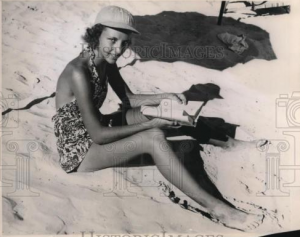
Anne Marie In Bermuda
The Course of True Love

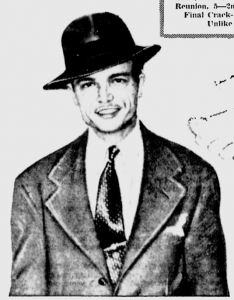
Early Life and Education
Anne Marie was the daughter of stockbroker Martin Brown Saportas and Marion Tiffany. After her divorce from Martin, Marion set up housekeeping for herself and put Anne Marie, fifteen years old, in her own hotel apartment, and enrolled her in a business school to learn typing (perhaps the alimony was not all Marion had hoped for). This was a mistake. There Ann Marie fell for the twenty-year-old Gordon Watson Gillam (1917-1946), the son of a Scottish stationary engineer (i. e., janitor).
Gordon Watson Gillam
First Romance and Underage Marriage
Six months after meeting George, Ann Marie wrote to him (September 1938):
“Just think, only seven more days and we will be off to Maryland, Delaware, or Virginia, or someplace. It is all so wonderful I can hardly believe it. I was looking up Tennessee on the map and we’ll never get there.
“How much did you get for the dear old typewriter? For goodness sake, whatever you do, don’t go and spend it for then we’d be lost – and save all you can.”
Gordon pawned the typewriter, and with that money the lovers eloped to Elkton, Maryland, East Coast capital of quickie marriages. She was fifteen and he was he twenty-one. The marriage and honeymoon were over in a weekend, and Gordon and Ann Marie returned to business school, Gordon to his parents’ house and Ann Marie to her hotel apartment. They did not inform anyone of the new marital arrangement.
But Marion came across one of Anne Marie’s letters to her new husband and was extremely unhappy. She wrote to Gordon:
“I have just heard from my daughter of her marriage to you in September. I can’t tell you what an awful thing this was for you to do. You know she is only 15 a minor you took her out of State and married her a criminal offense. I think the best thing to do for both of you is to have it annulled as soon as possible, and until that is done I expect you to leave her alone, not phone or write or try to see her.
“Please send me the marriage license immediately I will expect it by Friday or I will send my lawyer over to see you and your parents, if you have any.
“It won’t be very pleasant for you if I have to go to law about it, which I shall do if you don’t do what I demand. You know you have broken the Mann Act, as any lawyer will tell you.
Marion rusticated Anne Marie to her aunt’s in Lawrenceville, Long Island. There Anne Marie wrote to Gordon: “Now, we have to sometime so why not now discussing the practicle [sic] side of things. We have to live someplace, don’t forget.
Ann Marie continued to be inconsolable. In January 1940 she wrote:
“I love you so, Gordon, more than anything else in the world. You should be mine, all mine, and I should be yours. If you asked me to run away again, I’d do it. The other night, I wanted you so badly, I wanted to die.
“I sit by the bed with a razor blade in my hand, waiting to slash my wrists, yet not finding the courage to do so. I always keep your picture by my bed and take it out of the frame and read what’s on the back –‘To my darling wife, from a devoted husband.’ I wash we could always be that to each other.
“Oh Gordon, I don’t care anything about pride, about anything but you. Please take me back.”
And again she wrote, “My Darling – I’ve been thinking about you and crying all day. Please write me soon. When I went to church, I prayed to God not to keep us apart, any more. Can’t we go to some place, far away, together? Oh Gordon, I am your wife, still. I do want you.
Again she protested, “Dearest Gordon: The one thing I’ll never regret is having married you. You have given me all the happiness I have ever known and I always want to make you just as happy. You’re all I’m living for.”
But then something happened. The annulment was in process and Gordon wrote back:
“I am sending enclosed your poisonous little letter of last week. My dear, it is my greatest desire that the annulment runs as smoothly and even more quickly than you wish. I wish you all the worst luck in the world, you richly deserve it.”
However, Gordon changed his mind and tried to contest the annulment, describing the last incident as a lover’s spat. But the court granted the annulment, and in October 1944 the lovelorn Gordon enlisted in the Army. When war came, he rose in the ranks.
The War Hero
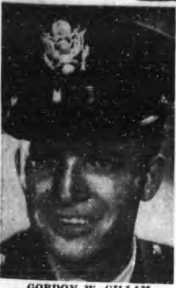
2nd Lt. Gordon Gillam
“Luck smiled on Second Lieutenant Gordon W. Gillam of Astoria when the Joseph Hewes went down off North Africa and he smiled right back, Gillam made shore safely, stopped at a bar In Casa Blanca for a drink and met a shipmate who carried word home to the army officer’s parents, Mr. and Mrs. Alexander Gillam of 27-72 12th street, that their son was safe.”
Gordon was promoted to Captain and received the Bronze Star and the Italian Order of the Crown Chevalier. But his luck ran out. He is listed as a war casualty. He died June 28, 1946 and is buried in the American Cemetery at Florence.
Double Trouble
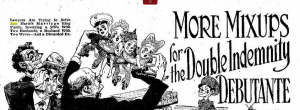
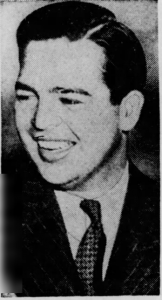
Wartime often produces matrimonial muddles (as was shown in the very touching movie The Miracle at Morgan’s Creek). Anne Marie got involved in an interesting one.
Ann Marie secretly married Marine Corps flying officer Lieutenant Allen Thomas Sturges (1923-2002) in Vermont in July 1941. Sturges was a “playboy, ” a “socialite,” a member of what my late mother-in-law called Café Society; they were not respectable.
Allen Thomas Sturges
Sturges went off to war, Anne Marie got lonely, and in early 1942 she married First Sergeant Jerome Mark (1919-1996); but she neglected the formality of a divorce from Sturges. Four days after the marriage Jerome was shipped overseas. When her mother Marion heard of the arrangement, she expressed her bewilderment. Anne Marie explained why Sturges didn’t count: “Why we weren’t really married. We were just kids.”
In 1944 a man called her and asked if she were the wife of Allen Thomas Sturges. This time she said yes. She learned that the man on the phone was the father of Judith Scott (1921-?), who had married Sturges, who had told her he was single. Ann Marie had married Allen and then married Mark. Allen had married Ann Marie and then married Judith. No divorces intervened. Double bigamy?
Crime and an Unsuccessful Suicide
Sturges received a medical discharge from the Marine Corp. In 1945 he was tried for stealing diamond cuff links and a gold cigarette case from the home of actor Bruce Cabot. Sturges pleaded not guilty by reason of insanity; he was fined $500 and ordered to leave California.
In 1949 Sturges was working in upstate New York for HydroCarbon Research and then moved to Brownsville. Texas, where he worked in the aluminum welding division at a plant his company was helping to build. Soon local police were seeking Sturges on charges of removing a mortgaged automobile and passing bad checks. He had forged Anne Marie‘s name to several checks.
In October 1949 Sturges drove the stolen car to Houston and checked into an expensive hotel under the name of Stevens. Through mutual friends Sturges met Braniff airline hostess Marion Yturria and told her of his legal problems in Brownsville. He told her “it would be a lot less worry for everyone if I just ended it all.” She was frightened; he telephoned her at her office and she called the police. They told her not to go home alone; she took two friends, and they discovered that Sturges had broken in and shot himself through the right temple. Yturria was greatly upset by the indent, but she told the papers:
“He was a gentleman the whole time I knew him. He made no amorous attempts toward me. I don’t think you can blame anybody but the war. It’s just an unfortunate tragedy that could have happened to anyone.
He survived, but the bullet lodged in his brain. To his surgeon’s astonishment, Sturges survived and recovered,
He had left three suicide notes in his pocket, one with identifying information, one to Miss Yturria: “I want to thank you for your help. You are the best friend a man could want – if I had known you longer I would have loved you – But, you are too good a woman for a person like me – Just say a prayer for me once in a while.”
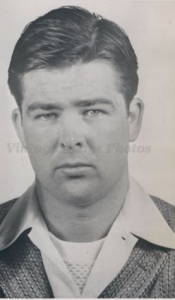
And one to his mother: “My last will and testament: To my mother I will everything, insurance, etc. My body must be cremated. Mother, I love you.”
His mother expressed doubts that Allen had shot himself, despite the three suicide notes, and she admitted that he was suffering from a “war neurosis.” Four hours before the shooting, a New York paper had received an anonymous tip that Sturges had killed himself, but there were no long distance calls from Houston to that newspaper. Mrs. Taveniere said she had gotten a telephone call that gamblers had pursued her son to Houston and shot him. But the allegations were never resolved.
Allen Thomas Sturges 1955
Sturges, “unemployed mechanical engineer” in 1955 was sent to Bellevue for observation after he robbed an East Side bar. He died in 2002.
More Marriages
In 1948 Anne Marie married (?) William S. Vanbuskirk in Nevada. She married Wayne W. Dickinson in October 1959 in California. She married Paul R. White (?-?) in 1963 in California. She then married Joseph Chamberlain who was Ann Marie’s (third? fourth? fifth?), in any case, last husband. They got hitched in Nevada in 1970.
One of these unions produced a son, Thomas Saportas (father’s name not listed on birth certificate), who was adopted as Thomas Michael Leahy. He contacted his birth mother in 1984 when she was living in Sherman Oaks, California. He also visited her in Pahrump, Nevada in 2014, and believes she died in 2016.