Leroy Place
Architect
Alexander Jackson Davis (1803–1892) was one of America's most influential architects of the 19th century, renowned for his mastery of the Picturesque movement and his versatile work across multiple revival styles, including Greek Revival, Gothic Revival, Italianate, and Egyptianate. Born in New York City, he began his career as a draftsman and partnered early with Ithiel Town, contributing to landmark designs like the New York Custom House and various state capitols. After parting ways, Davis became a leading figure in country house design during the 1840s–1850s, advocating for romantic, asymmetrical compositions that harmonized with natural landscapes—exemplified in masterpieces like Lyndhurst (Tarrytown, NY) and contributing to Leroy Place as an early urban project showcasing his Federal-style elegance before his shift toward more eclectic and Gothic forms.
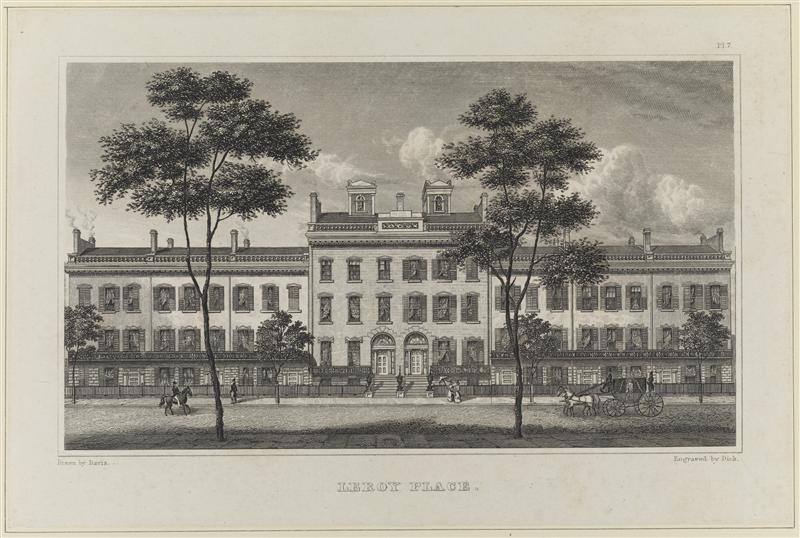
Architectural Description Leroy Place was conceived as a unified residential terrace modeled on the “terraces” of London: a continuous row of identical attached townhouses designed as a single architectural composition rather than as individual speculative houses. The development consisted of Federal-style row houses, harmonized by consistent height, materials, and proportions, and set back behind small but orderly front yards that reinforced the sense of elegance and uniformity.
Isaac G. Pearson commissioned the architect Alexander Jackson Davis, one of the leading American architects of the period, to design the terrace. The houses were constructed of granite, an unusually substantial material for New York row houses of the era, underscoring the ambition and expense of the project. The restrained Federal detailing, regular fenestration, and disciplined rhythm of the façades gave Leroy Place a distinctly refined character, setting it apart from more piecemeal urban development.
History Leroy Place was developed in the early nineteenth century by Isaac G. Pearson, who not only built the terrace but successfully persuaded the city to rename the block in honor of the development. The name “LeRoy Place” commemorated Jacob LeRoy, a prominent Knickerbocker merchant, thereby linking the project to established mercantile prestige.
According to Gotham: A History of New York City to 1898, the Federal-style houses sold for the substantial sum of twelve thousand dollars each, placing them firmly in the upper tier of the city’s residential market. The terrace quickly attracted residents from some of New York’s most prominent families, including the Stuyvesants, Clintons, and Beekmans, reinforcing its status as a fashionable and socially significant address.
Among its residents was Edward T. Thebaud (1798–1854), a member of the prominent Thebaud mercantile family, who lived at Leroy Place alongside these well-connected neighbors. His presence there situates Leroy Place within the broader social and economic networks of early nineteenth-century New York commerce and society.