Lawrence House at 45 East 59th Street
Architect in 1903
Bradford Lee Gilbert (1853–1911) was a prominent New York architect whose career bridged nineteenth-century masonry traditions and the emerging age of steel-frame construction. He is best known for designing the Tower Building (1889) at 50 Broadway, widely regarded as New York City’s first true skyscraper and an early experiment in steel-frame, curtain-wall construction. Gilbert also maintained a large and varied practice that included railroad stations, institutional buildings, and elite private residences. In residential work, he was particularly skilled at dramatic remodelings, as in his 1903 Beaux-Arts transformation of 35 East 67th Street for J. Henry Alexandre, where he reimagined an earlier Victorian brownstone as a modern, French-influenced townhouse.
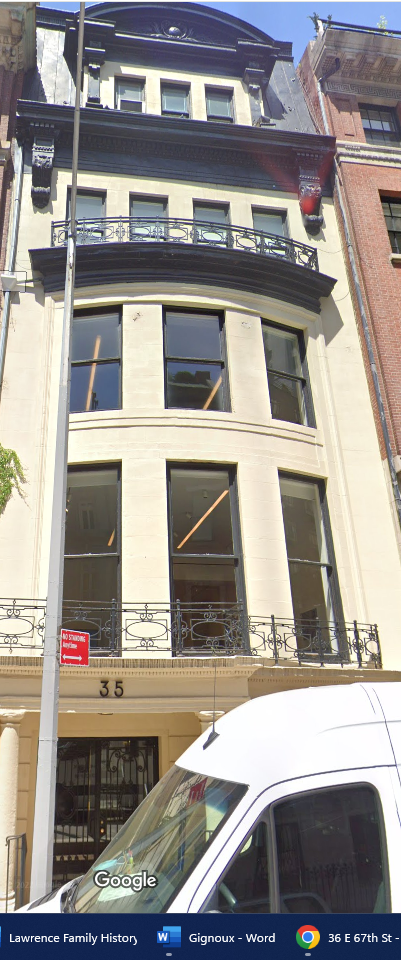
Architectural Description As remodeled in 1903, 35 East 67th Street became a refined Beaux-Arts townhouse with strong French influences. The renovation removed the original Victorian brownstone façade and stoop, replacing them with a smooth stone exterior and a street-level entrance. The façade is organized vertically with large, curved and rectangular window groupings, wrought-iron balconies, and a pronounced mansard roof, giving the building the character of an early twentieth-century Parisian hôtel particulier adapted to a New York townhouse scale. Although the structural core of the 1881 building was retained, the exterior and principal interior arrangements were thoroughly modernized to reflect Edwardian-era tastes and the social ambitions of its owner.
In 1903, the house was purchased from the Joseph Suydam Stout family by James Henry Alexandre, a prominent New York shipping and business figure, and his wife Elizabeth Boyce Alexandre. Alexandre immediately commissioned Bradford Lee Gilbert, one of New York’s most innovative architects, to remake the house as a fashionable private mansion. The Alexandres resided there until Henry Alexandre’s death in 1912, after which the property passed through heirs.
By the mid-twentieth century, the house had been altered from its original single-family use and converted into apartments, reflecting broader changes in Upper East Side residential patterns. In the late twentieth and early twenty-first centuries, the building became associated with the neighborhood’s gallery district, housing high-end art and rare-book dealers while retaining much of its architectural character.