Lawrence, Cornelius Van Wyck (1791–1861)
U.S. Congressman, Mayor of New York City
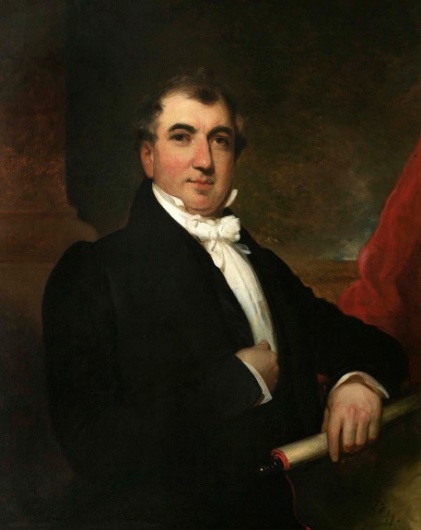
Parents: Henry Lawrence (1767–1824) and Harriet Van Wyck (1771–1812)
Spouse: (1) Maria C. Prall (1797–1820); (2) Rachel Ann Hicks (1798–1838); (3) Lydia Ann Lawrence (1811–1879)
Children: Henry Van Wyck Lawrence (1821–1890) and others (full list follows in later installment) Kinship: First cousin five times removed of the post–World War II Smith generation
Early Life and Family Origins
Cornelius Van Wyck Lawrence was born on February 28, 1791, into two old Long Island families whose roots reached back into the early colonial period. Through his father, Henry Lawrence, he descended from the Flushing branch of the Lawrences, a family noted for enterprise, local leadership, and an occasional taste for political controversy since the seventeenth century. His mother, Harriet Van Wyck, brought him the Dutch heritage of the Van Wycks, a family respected for public service and property holdings in Queens and Manhattan. This dual inheritance connected Cornelius to a social world in which family alliances, business ventures, and civic duty were tightly interwoven.
Although influenced by Quaker relatives, Cornelius grew up in a New York that was changing swiftly from a provincial seaport into a rising commercial capital. The harbor thronged with ships from the West Indies, Europe, and Asia; the streets bustled with sailors, merchants, and carters driving loads of imported goods toward warehouses and auction rooms. New York was a place where fortunes could be made or lost in a single season, where fires swept through wooden neighborhoods, and where newcomers jostled with old families for position and prosperity.
Entry into Business: Shotwell, Hicks & Co.
In 1812, Cornelius entered the auction and dry-goods firm of Shotwell, Hicks & Co., located on Pearl Street. At that time, auction houses were among the vital organs of New York commerce, handling everything from bankrupt stock to European luxury goods and cargoes newly arrived from the Caribbean or China. The atmosphere was competitive and often hectic, for buyers and sellers crowded the rooms, and the auctioneer’s voice had to rise above the clamor inside and the noise drifting in from the street.
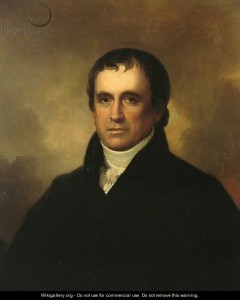
Cornelius soon proved himself an able and trustworthy young merchant. The firm later became Hicks, Lawrence & Co., signifying his advancement. His association with the Hicks family extended beyond business. In 1821, he married Rachel Ann Hicks, daughter of Willett Hicks, a well-known Quaker minister and respected merchant. Willett was a figure of some fascination in his day, for he was widely said (though disputed at the time) to have visited the deist Thomas Paine during his final illness. Through the Hickses, Cornelius entered a wider circle of merchants, religious leaders, and civic influencers whose combined influence extended into politics as well as trade.
Willett Hicks by Rembrandt Peale
Marriage and Family Interconnections
Cornelius’s personal life further strengthened his ties within New York’s closely linked merchant families. His first marriage, to Maria C. Prall, was brief; she died in 1820, only a few years after their union. His second marriage, in 1821, to Rachel Ann Hicks, deepened his connection to the Hicks family, blending commercial, religious, and social networks. This union brought Cornelius into the orbit of influential Quaker households whose members were active in business, reform efforts, and civic affairs.
After Rachel’s death in 1838, Cornelius married for a third time, choosing as his wife Lydia Ann Lawrence, a cousin from the Bayside branch of the family. Lydia had first married her cousin, Edward Newbold Lawrence, who died young, leaving her a widow. Her second marriage, to Cornelius, created yet another link between the Flushing and Bayside Lawrences. These unions were not unusual among old New York families, who valued trusted kinship ties and often preferred to keep property, business interests, and religious associations within the family circle. Later family commentators jested that the Lawrence genealogy resembled a tumbleweed rolling across generations, gathering additional Lawrences as it went.
Prosperity and Retirement from Business
By 1832, Cornelius had retired from active business with what contemporary accounts described as a considerable fortune. His timing proved fortunate. The Panic of 1837, which followed a period of speculative expansion and political struggle over the national banking system, ruined many merchants and left former associates facing bankruptcy. Cornelius, having withdrawn from the firm in advance of the crash, was largely shielded from the worst consequences. His early success gave him financial independence and the freedom to enter public life without dependence on business income.
Foreshadowing a Double Life
Although admired in business circles and well connected through marriage, Cornelius was also known to enjoy the livelier social world available to well-to-do New Yorkers. He moved with ease among merchants and civic leaders, but he was not immune to the entertainments that flourished in the growing city. The theaters, clubs, and “sporting” establishments of Manhattan offered diversions for men of means, and Cornelius’s name would later surface in anecdotes about the more colorful side of urban gentlemanly leisure. In time, these habits would contribute to one of the most whispered-about episodes of his life, when private indiscretions became the subject of attempted blackmail. The full account of that affair belongs to a later section, but its roots can be traced to this period, when his public respectability coexisted with a taste for metropolitan amusements.
Turning Toward Public Office
With financial security established, Cornelius began to shift his attention from commerce to public service. The early nineteenth century offered increasing opportunities for successful businessmen to enter political life. New York, then in the midst of rapid population growth and expanding municipal responsibilities, needed men of experience to serve in government. Cornelius’s reputation for business judgment and his connections among merchants and civic leaders made him a natural candidate. His entry into politics would soon draw him into the turbulence of national debates over banking, currency, and executive power, and would set the stage for his rise to the mayoralty of New York City.
Election to Congress (1832–1834)
Cornelius was elected to the United States House of Representatives in 1832 as a Jacksonian Democrat. His election reflected both his standing in New York’s business community and the growing influence of Tammany Hall, which championed expanded suffrage and the political power of the “common man.” Once in Washington, he aligned himself with President Andrew Jackson’s administration, which was engaged in an increasingly bitter struggle with Nicholas Biddle’s Bank of the United States. Although Cornelius had personal experience with banking and, according to later critics, initially regarded the national bank as useful to commercial stability, party loyalty and political calculation drew him into supporting Jackson’s efforts to dismantle it.
As the Bank War intensified, Cornelius found himself in a difficult position. His opponents later claimed that he had privately expressed reservations about removing federal deposits from the Bank of the United States, but nevertheless voted with the Jacksonians. His enemies seized upon this. Citing his own letters, they said “His judgment was avowedly on one side and his votes on the other. The prospect of adding to his wealth by the sacrifice of his opinions were in one scale–honor and honesty were in the other –in private …he admitted the removal (of the public treasury) was inexpedient.”
They continued: “Yet he voted for the removal on a pledge, well kept, that he would get the fingering of two millions of dollars of these deposits himself, for a bank to be started in Wall street, with special privileges, and called the Bank of the State of New York, of which he and his cronies should have the control, the jugglery of disposing of its shares, etc.
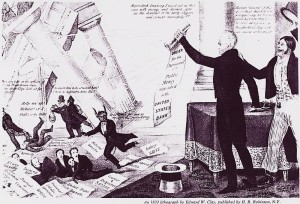
When Cornelius visited New York and his merchant friends asked for an explanation of his actions, he explained that “he had bound himself BY A WRITTEN PLEDGE to uphold the party. Such was his sense of the embarrassments of his situation that HE ACTUALLY WEPT.”
Accusations circulated that he had agreed to support Jackson’s policy in exchange for future influence in the management of state banks that would receive federal deposits. Although such claims were part of the rough political combat of the day and cannot be taken at face value, they show how his business background made him a target for suspicions of self-interest.
A City in Transformation
When Cornelius returned to New York from Washington, he stepped into a city undergoing rapid change. Immigration was swelling the population; new wards and neighborhoods were expanding northward; and issues of public health, water supply, policing, and municipal finance demanded new approaches. The city government—long dominated by a small circle of elites—was evolving toward a more democratic model, and political competition was fierce. Tammany Hall, Whig reformers, and nativist groups contended for influence in a volatile atmosphere in which elections could be as tumultuous as any street market.
The New York Mayoral Election of 1834
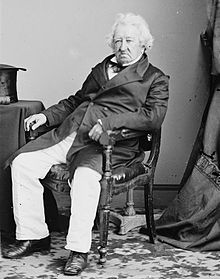
Verplank, The Man with the Soul of a Poet
The shift toward popular election of the mayor gave Cornelius an opening for civic leadership. In 1834 he became the first mayor of New York City to be chosen directly by the voters, rather than appointed by the Common Council. Prior to 1834 mayors of the City of New York had been appointed, first by the colonial government, and then by the Common Council, the predecessor of the City Council. In the spirit of democracy, it was decided to let the voters of New York elect the sixty–first mayor. Cornelius Lawrence ran as a Tammany Democrat against Gulian Crommelin Verplanck, the Whig candidate, a poet and former Democrat.
His enemies described Cornelius’s decision to run in these terms: “the crying congressman, the weeping stock–jobber could have resigned had he disliked the party drill — but it brought him plunder, and he blubbered and held on, and afterwards he lent his name as a candidate for the mayoralty to uphold the gamblers he voted with in public…”
The mayoral election of 1834 was everything the nativists feared. They had warned that: “This country never committed a more fatal mistake than in making its naturalization laws so that the immense immigration from foreign countries could, after a brief sojourn, exercise the right of suffrage. To ask men, the greater part of whom could neither read nor write, who were ignorant of the first principles of true civil liberty, who could be bought and sold like sheep in the shambles, to assist us in founding a model republic, was a folly without a parallel in the history of the world, and one of which we have not yet begun to pay the full penalty.”
An observer described the democratic electoral process: “On the occasion we speak of a gang of Jackson shoulder–hitters, headed by an ex–Alderman, and armed with clubs, sling–shots, and knives, broke into the committee–room of the opposing faction and nearly killed some 15 or 20 of them. Then they tore down the banners, destroyed the ballots, and made a wreck of everything. The Whigs asked the Mayor for help, but he would not furnish it, alleging that all his forces were engaged. The Whigs were left to protect themselves and they did it. In these times elections lasted three days. The second morning Masonic Hall was packed with Whigs who meant to crush the mob. They had a battalion 1,800 strong ready to march at a moment’s notice.
This had the effect of keeping the peace and keeping free access to the polls. But the roughs were all the time firing up with drink, and on the third day were ready for anything. Early in the forenoon they tried to capture from a Whig procession the little miniature frigate Constitution. This led to a fierce conflict in front of Masonic Hall. The hall was assaulted, and the Mayor, Sheriff, and 40 Watchmen, were finally driven off. The Mayor [Gideon Lee] was wounded, and Police Capt. Flagg was killed. The rioters rushed into the hall, and the Whigs were forced to fly through the windows. The Mayor declared the City in insurrection, and called for help from the Navy–yard and Fort Columbus, but the Federal officers could not interfere. Finally, Gen. Sandford called out the military. Even with the military, which was largely pro–Jackson, on his side. Lawrence won by only 181 votes.”
The Stage Set for Conflict
Cornelius entered office at a moment when political passions ran high and the city’s institutions were under strain. The national banking controversy had unsettled financial markets; economic uncertainty loomed; and resentments simmered among working-class immigrants who faced competition for jobs, housing, and social standing. Conflicts over abolition, religion, and immigration—especially between established Protestant communities and newly arrived Catholic Irish—were intensifying. In this charged atmosphere, a spark could ignite widespread unrest.
During Cornelius’s tenure as mayor, that spark was lit. The anti-abolition disturbances that broke out in the summer of 1834, known as the “Farren Riots,” shook the city for four nights. Mobs targeted the homes, businesses, and churches of Black New Yorkers and white abolitionists, exposing deep divisions in urban society. How Cornelius responded, what forces drove the violence, and how these conflicts influenced his later reputation will be explored in the next section.
The Anti-Abolition / “Farren” Riots
The Anti–abolitionist riots of 1834, the Farren Riots, occurred in over four nights, beginning on July 7, 1834. Their origins lay in the combination of nativism and abolitionism among the Protestants who had controlled the city since the Revolution, and the fear and resentment of blacks among the growing underclass of Irish immigrants.
The urban rumor mill was busy manufacturing stories: “In May and June 1834, the silk merchants and ardent Abolitionists Arthur Tappan and his brother Lewis stepped up their agitation for the abolition of slavery by underwriting the formation in New York of a Female Anti–Slavery Society. Arthur Tappan drew particular attention by sitting in his pew with Samuel Cornish, a mixed–race clergyman of his acquaintance. By June, lurid rumors were being circulated by the champion of repatriating “colonization,” James Watson Webb, through his newspaper Courier and Enquirer: abolitionists had told their daughters to marry blacks, black dandies in search of white wives were promenading Broadway on horseback, and Arthur Tappan had divorced his wife and married a black woman.”
So the Irish, resenting competition from free blacks, rioted.
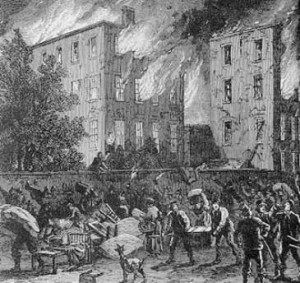
On Wednesday evening, July 9, three interconnected riots erupted. Several thousand whites gathered at the Chatham Street Chapel; their object was to break up a planned anti–slavery meeting. When the abolitionists, alerted, did not appear, the crowd broke in and held a counter–meeting, mocking the “black style” of preaching and calling for deportation of blacks to Africa.
The mob targeted homes, businesses, churches, and other buildings associated with the abolitionists and African Americans. More than seven churches and a dozen houses were damaged, many of them belonging to African Americans. The home of Reverend Peter Williams, an African-American Episcopal priest, was damaged, and his St. Philip’s African Episcopal Church was utterly demolished. One group of rioters reportedly carried a hogshead of black ink with which to dunk white abolitionists. In addition to other targeted churches, the Charlton Street home of Rev. Samuel Hanson Cox was invaded and vandalized. The rioting was heaviest in the Five Points.
the riots were finally quelled when the New York First Division (swelled by volunteers) was called out by the Mayor on July 11 to support the police. The "military paraded the streets during the day and the night of the 12th.: they were all furnished with ball cartridge, the magistrates having determined to fire upon the mob, had any fresh attempt been made to renew the riots."
Water, Sanitation, and the Croton Aqueduct Project
One of the most pressing concerns facing New York during Cornelius’s mayoralty was the city’s inadequate water supply. For decades, residents had relied on wells, cisterns, and private pumps, many of which were contaminated or insufficient for a growing population. Public health, fire protection, and basic sanitation required a far more reliable and abundant source of fresh water.
Cornelius supported the early stages of what would become one of the greatest civic engineering achievements of nineteenth-century America: the Croton Aqueduct. The concept of bringing fresh water from the Croton River in Westchester County to Manhattan had been discussed for years, but during his administration the planning and initial momentum accelerated. Although the aqueduct would not be completed until 1842, his tenure marked a significant step toward transforming New York into a healthier, safer, and more resilient city.
The Great Fire of 1835 and Its Aftermath
In December 1835, only months after Cornelius left office as mayor, New York experienced one of the most devastating urban fires in its history. Beginning on a bitterly cold night, the blaze swept through the heart of the city’s commercial district around Wall Street, consuming warehouses, offices, and many of the most valuable buildings in the metropolis. More than 600 structures were destroyed, and the financial losses were immense.
Although Cornelius was no longer in office, the catastrophe underscored the pressing need for the very improvements that had begun to gain traction during his administration. The inadequacy of the city’s water supply, already recognized as a public health problem, proved disastrous in the face of such a fire. Fire companies struggled to combat the flames, and the urgency of completing the Croton Aqueduct became unmistakable. In the years that followed, the city undertook major reforms to improve fire protection, infrastructure, and urban planning—initiatives that built on foundations laid during Cornelius’s tenure.
Collector of the Port of New York
After serving as mayor, Cornelius continued his public career when President Martin Van Buren appointed him Collector of the Port of New York in 1837, one of the most influential federal posts in the nation. The position carried considerable responsibility for customs administration, revenue collection, and oversight of maritime commerce at what was rapidly becoming the country’s principal port of entry, and tariffs supplied a principal source of revenue for the Federal government.
Cornelius held this office until 1841 and again for a period thereafter, navigating the duties of a role that required both administrative ability and political tact. The Collector’s post was seen as a mark of high confidence within the Democratic Party, and his appointment affirmed his standing as a trusted public servant with substantial experience in commerce and government.
Later Financial and Civic Roles
Beyond elected office, Cornelius remained deeply engaged in the financial and civic life of New York. Over the course of his career, he served as president of the Bank of the State of New York for many years, guiding the institution through periods of economic expansion and contraction. He also held directorships and trustee positions in a number of financial and insurance organizations, including the Bank of America, the New York Life and Trust Company, and prominent fire insurance companies.
His participation in these institutions reflected the close relationship between public service and civic responsibility that characterized New York’s leadership in the nineteenth century. Cornelius belonged to a generation of merchant-statesmen who considered it a duty to contribute their business experience to the development of public and charitable institutions.
Private Life and Scandal
Life was not all work and no play for Cornelius. An older history of New York has the tantalizing outlines of a story: Cornelius “had the ice cream and strawberries of everything in life–in commerce, in politics, in wives, in finances and in religion…. He had a peculiar way of carrying his spectacles behind his back while he looked at all the pretty girls he met: “One of them led him a sad dance. Mr. Lawrence, the most respected man in the city, was led into an ambuscade and made the victim of a plot. It was a sad business, lost the old gentleman a great deal of money, and caused him any quantity of mental misery.”
What had happened is that Cornelius, like almost every other male in New York over the age of 14, had participated in the Sporting Life. This was a libertine male culture, revolving around sports and prostitutes. Cornelius paid blackmailers $100,000 (about $3,000,000 in 2025 dollars, what one reference work estimated as his net worth) to keep his past quiet, so his indiscretions must have been truly spectacular.
The Sacramento Daily Union of November 18, 1856, reported “The Heavy Black Mail Operations. — Some months ago, as will be remembered, Ex–Mayor Cornelius W. Lawrence preferred a charge of perjury against Mr. A. Brown, formerly a Deputy U. S. Marshal of this city, for swearing falsely in one of the Law Courts. It was expected that, during the examination into the merits of this charge of perjury, certain facts relating to enormous black mail operations, which Brown practiced upon the Ex–Mayor, at intervals during a period of eighteen years, by which he obtained from Mr. Lawrence over $100,000, would be brought to the notice of the Court, but owing to the continued absence from Court of Mr. Lawrence on every occasion, when the case was to have been examined, the magistrate, Justice Flandreau, was determined to dismiss the complaint, and did so. Brown, it will be remembered, was stated to have been in possession of certain secrets touching the Ex–Mayor’s intimacy with a female twenty years or longer ago, and by means of threats to expose, he succeeded in getting from Mr. L. large sums of money at various times, in the aggregate amounting to over $100,000.
“For years the Ex–Mayor suffered the infamous extortion to go on, but finally he refused giving Brown any more money and then only the circumstances of Mr. L.’s youthful indiscretion was made public, although some of his friends knew of it years ago, and advised him not to give Brown a cent, but to let him make the expose and then have the affair cleared up. Mr. Lawrence, however, declined this course, and has, accordingly, suffered from Brown’s extortions. The latter was under bonds of $5,000 to answer the charge of perjury, but is now discharged and his bondsmen liberated. He was formerly owner of a public house called “the Red House,” at Harlem, and for years past has lived extravagantly.
The Red House tavern in Harlem was a mecca of the fast set’s “manly sports,” sports which were not limited to cricket and horse racing.
Death and Burial
Cornelius Van Wyck Lawrence died on February 20, 1861, closing a life that had spanned a transformative period in New York’s emergence as a commercial and political center. He was interred in the Lawrence family plot at Bayside, a resting place for many members of the extended family whose lives shaped the history of Long Island and New York City.
Legacy
In honor of his service as Collector of the Port of New York, the revenue cutter Cornelius W. Lawrence was named after him. It had a brief and checkered history. It was a Baltimore clipper (i.e., fast), built in Foggy Bottom, and commissioned in October 1848.
“She was assigned to the west coast, with Captain Fraser’s orders being to secure the revenue, enforce U.S. laws on the seas, aid distressed vessels, and to sound and chart the new territory’s harbors and inlets. With a crew of 43 aboard, with most of Fraser’s officers being political appointees with no seagoing experience, Lawrence set sail for the Pacific on 1 November 1848 around Cape Horn. After an arduous voyage of over 11 months, including five weeks spent attempting to sail around the Horn, she arrived in San Francisco on 31 October 1849.
“Difficulties soon visited the cutter though when the crew learned of the vast fortunes being made by those hunting gold inland and Fraser soon found himself without a crew. Even his officers resigned to join the gold rush.”
Eventually the Lawrence sailed again, and went to San Diego, the Hawaiian Islands, and back to San Francisco to help put down mutinies. She ran aground and was lost at the entrance to San Francisco Bay on the night of 25 November 1851. All hands were saved. But in 1982 she was (largely) duplicated and given the name the Californian, becoming the state’s own tall ship.
After his death Cornelius had a fireboat named after him, presumably in honor of his work in the Volunteer Fire Department and his work in bringing water to New York City to prevent fires. It had a longer career.