Lawrence, Augustine Hicks (1770–1828)
Mayor of New York City
Parents: Augustine Lawrence (1719–1794) and Joanna Annajte van Zandt (1729–1809) Spouse: (1) Catherine Abramse Luquer (various spellings) (dates as given: 1729–1809); (2): Eloise Lawrence Bogart (1799–1880). Children: Augustine Nicholson Lawrence (1793–1872), Elizabeth Mastier Lawrence (1796–1843), Joanna Lawrence (1797– ), Sarah Middagh Lawrence (1799–1873), Eliza Augustine Lawrence (1804–1881), Sarah Augustine Lawrence (1807–1888) Kinship: Third cousin six times removed of the post–World War II Smith generation
Early Life and Family Augustine Hicks Lawrence was born into a well-connected New York mercantile family. Through his parents, he was linked to established Dutch and early colonial lines in Manhattan and Brooklyn, including the van Zandt family. His first marriage was to Catherine Abramse Luquer, from a prominent Brooklyn family of French Huguenot descent, whose surname appears with multiple spelling variants in the records. After Catherine’s death, he married Eloise Lawrence Bogart.
New York Stock Exchange Augustine Hicks Lawrence is remembered as the youngest of the twenty-four stockbrokers who signed the Buttonwood Agreement on May 17, 1792, often described as the founding moment of the New York Stock Exchange. The brokers met under a buttonwood tree outside 68 Wall Street to agree upon uniform commission rates and cooperative practices. The organization adopted its constitution on March 8, 1817, as the “New York Stock & Exchange Board,” later the New York Stock Exchange.
Business and Public Life Lawrence was active in commercial, banking, and civic affairs. He was a partner in several firms, including Lewis & Lawrence; Augustine H. Lawrence & Co.; and Augustine H. Lawrence & Augustine N. Lawrence (with his son). By 1795, his business was located at 40 Wall Street. He became a close friend of DeWitt Clinton, multiple-term Mayor of New York, and earned the nickname “The Chancellor of the Exchequer” for his management of city financial affairs as chairman of the finance committee and alderman of the Third Ward. He held directorships in the New York Insurance Company, Bank of America, Farmers’ Fire Insurance & Loan Company, Globe Insurance Company, and other enterprises.
The 1810 census records the household as owning two enslaved persons, a reminder that even prominent New York families in commerce and finance participated in slavery during the early nineteenth century. Also, manumission was restricted to prevent elderly former slaves from becoming charges upon public welfare.
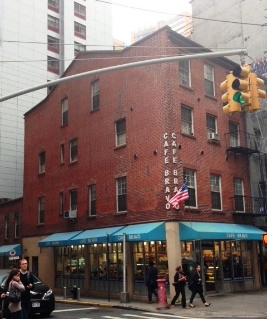
Residences and Legacy In 1799–1800, Augustine built a Federal-style row house at what is now 94 Greenwich Street (right). Remarkably, the house survived the large-scale destruction of its neighborhood and was designated a New York City Landmark in 2009. It is widely noted that its preservation was due in part to a later tenant, the Pussycat Lounge, a topless bar that occupied the building and unwittingly kept it from demolition.
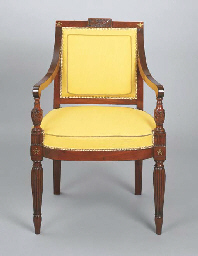
As alderman, Lawrence commissioned a set of chairs (left) for the new City Hall from the celebrated French-American cabinetmaker Charles-Honoré Lannuier at a cost of fourteen dollars each. These chairs reflected the neoclassical elegance of the period and the civic aspirations of the young city.
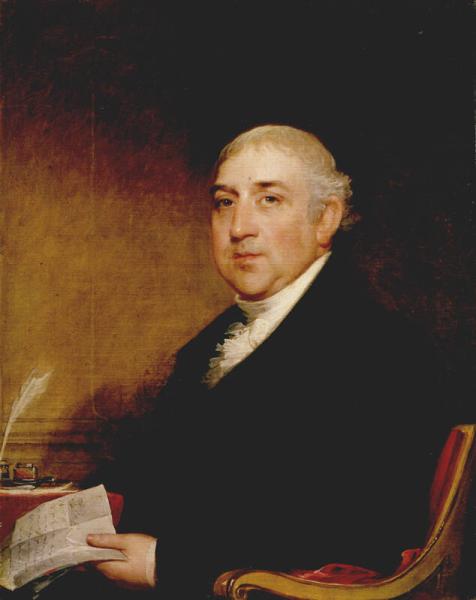
Portrait A portrait of Augustine Hicks Lawrence, attributed to Gilbert Stuart and dated circa 1812–1815, was given to the New-York Historical Society by his granddaughter, Eloise Lawrence Breese Norrie.