Jones, Sir Lawrence John, 4th Baronet (1857–1954)
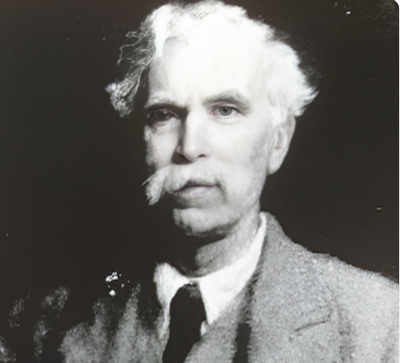
Education and Career Lawrence John Jones was educated at Eton and Trinity College, Cambridge. From 1917 to 1934 he was a member of the council of the Charity Organization Society and from 1928 to 1929 served as President of the Society for Psychical Research.
Psychical and Spiritualist Interests Sir Lawrence’s name is well known in the history of English psychical investigation. In 1900, while living in the south of France, he hosted a home séance circle that included the amateur medium Miss Kate Wingfield (referred to as “Miss A.” in F. W. H. Myers’s Human Personality). Communications were received by raps and automatic writing.
On 8 September 1900, Miss Wingfield, under spirit control, produced a message purportedly from Sarah Willett of 7 Sydney Street, London, claiming she had been shot and killed by one Jack Parr, a polisher of Green Street. On 30 September Miss Wingfield experienced a vision of this girl, and on 2 October saw a “figure with a black thing like a sack tied over his head and shoulders.” Raps spelled out “John Parr hanged today.” According to later records, Sarah Willett expressed fear that her murderer, now dead, would exact vengeance “on the other side.” Eventually the spirit of John Parr also communicated, first with threats, later peacefully, and even dictated a recipe for furniture polish that reportedly proved serviceable.
Sir Lawrence’s own approach to psychic phenomena was characteristically empirical rather than credulous; he sought to test claims under controlled conditions and to maintain scientific discipline in the Society for Psychical Research.
Controversy with Sir Arthur Conan Doyle During his presidency of the Society for Psychical Research, Sir Lawrence became involved in a notable dispute with Sir Arthur Conan Doyle concerning the society’s treatment of certain séances conducted by the Italian medium the Marquis Scotto of Millesimo. The editor of the Proceedings, Theodore Besterman, had published a skeptical review of the sittings, suggesting possible fraud. Sir Arthur protested vehemently, writing to Sir Lawrence to denounce the article as “a series of misrepresentations and insulting innuendoes” and charging that the society had become “anti-spiritualistic.”
Doyle’s letter, reprinted in The Daily Express, announced his resignation after thirty-six years of membership and accused the society of “unscientific and biased work.” He urged others to resign as well. Sir Lawrence and the honorary secretaries replied in a circular to members, observing that “to Sir Arthur Conan Doyle spiritualism is, to use his own phrase, a cult,” and that he considered any criticism of its phenomena “unreasonable and vicious opposition.” They pointed out that the séances in question were held in total darkness, without proper controls, and that Doyle’s claim that they represented “the very highest possible level of psychical research” was untenable.
Doyle, interviewed by The Daily Express, responded that “we want more experiments and knowledge, and to secure that it is necessary for the society to have more sympathetic people in the seats of the governors.” The exchange epitomized the growing divide between scientific psychical researchers and convinced spiritualists.
Personal Experiences Sir Lawrence’s interest in psychic matters may have been reinforced by personal experiences. At the time of the unexpected death of his father, Sir Willoughby Jones, both he and his brother Herbert (later Suffragan Bishop of Lewes) reported striking impressions. Lawrence, some miles away, awoke with a feeling of dread at the exact hour of his father’s death. Herbert later testified that he heard a voice calling his name twice during the night, followed by the sound of men carrying something from the upper story; as the noise passed his door, it flung open of itself. The next morning, a telegram arrived announcing their father’s death during the night.
Death Sir Lawrence John Jones died in 1954, having long been respected both as a country gentleman and as a conscientious investigator of psychical phenomena.