Hyde, Gavin (1930–2019 )
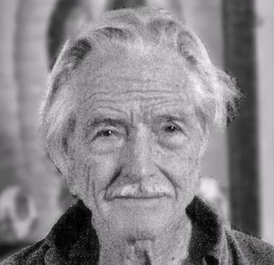
Early Life Gavin was the son of Bobby Hyde’s third marriage to Florence Tuckerman, the woman Bobby had loved since his youth and finally married after leaving Snedens Landing. He grew up in Santa Barbara, California, within the Mountain Drive community his father helped to found—a colony of artists, builders, and free spirits whose handmade houses and shared ideals defined postwar bohemian life on the California coast.
Education and Naval Service He attended Santa Barbara High School, graduating in 1948, and earned his bachelor’s degree from the University of California, Santa Barbara in 1952. He then served three years in the U.S. Navy, much of it on Guam, where, as he later told a News-Press reporter, “I was bored stiff out there, so I began to write short stories, mostly science fiction.” His first, “I Don’t Know You,” appeared in If magazine (May 1955), followed by others in If and Star Science Fiction Stories. His early fiction, praised for its humor and psychological realism, reflected the Cold War fascination with isolation and imagination.
Marriage and Family Life While attached to the American Embassy in Madrid, Hyde married María del Pilar Alvarez y Ruiz, daughter of Mr. and Mrs. Custo Ricardo Alvarez of Madrid. Their wedding, at La Iglesia Parroquial del Salvador de San Nicolás with reception at Mograda, was reported for its floral display and international guest list. The couple lived in the suburb of Avenida de las Acacias before returning to California; they divorced in 1968.
Academic and Literary Career After his naval service, Hyde joined the faculty of the University of California, Santa Barbara, where he taught English and creative writing. He published essays and stories exploring the intersections of modernism, imagination, and landscape. “Science fiction,” he said in a 1950s interview, “is the only kind of fiction that can absorb our chang0ing world and stay relevant.” Later he shifted toward teaching literature, language, and philosophy, and remained a participant in Santa Barbara’s literary scene.
Later Years and Mountain Drive Legacy Hyde spent the remainder of his life in the hills of Montecito, living amid the sandstone and chaparral of Mountain Drive. Even into his eighties, he continued maintaining the terraces and paths he had built by hand. In 2013, at age 83, he was trapped under a dislodged boulder while hiking near his home; neighbor Paul Dahl heard his faint cries, dug him free, and called for help. Hyde survived with only minor injuries and told the Santa Barbara News-Press: “You get up in the morning, have breakfast, and look out at those hills—it will make you well.”
A retired UCSB professor and former science-fiction author, Hyde remained known for his resilience, gentle wit, and lifelong connection to California’s bohemian heritage. His reflections
Legacy and Influence
Gavin Hyde represents a transitional figure in the Hyde–Tonetti lineage: the contemplative scholar within a family of builders, performers, and visionaries. Through him, the Mountain Drive experiment entered the literary and reflective realm. Whereas his father, Robert McKee “Bobby” Hyde, had given the movement its physical and communal form, Gavin chronicled its inner life—the idealism, craftsmanship, and utopian impulse that animated the community from the 1940s onward.
His essays and fiction preserved the ethos of postwar California’s bohemian enclaves at a time when their handmade, quasi-rural culture was vanishing under suburban development. To younger Santa Barbara writers and artists, Hyde embodied the “last of the Mountain Drivers”: a man who lived simply, worked with stone and words, and saw literature as an act of landscape stewardship. Former students at UCSB recalled his gentle, Socratic classroom manner and his insistence that creative writing required “listening to the hills.”
Locally, Hyde’s survival of the 2013 boulder accident became emblematic of his resilience and humor—qualities long admired by his circle of neighbors and former colleagues. In obituaries and reminiscences, he was remembered as a bridge between generations: a child of Santa Barbara’s artistic founders who carried their spirit into the intellectual life of the modern university.
Although his published work was limited, his presence in mid-century science fiction, his teaching at UCSB, and his stewardship of Mountain Drive’s memory give him a lasting place in the cultural history of California’s creative frontier. His blend of imagination, humility, and endurance remains a touchstone for descendants and admirers of the Hyde–Tonetti community.
Short Stories
Although Gavin Hyde’s published output was modest, his stories were distinctive for their quiet intelligence, wry tone, and attention to psychological and moral nuance—qualities that reflected both his California upbringing and his later academic sensibility. His fiction appeared in the leading science-fiction venues of the 1950s, during what historians now call the post-pulp literary turn of the genre
**“**I Don’t Know You.” If: Worlds of Science Fiction, vol. 1, no. 4 (May 1955). Hyde’s first published work, written while stationed on Guam. A surreal and unsettling story of mistaken identity and existential isolation, it earned him $125 and began his correspondence with editor James L. Quinn.
“The Sun-Touched Planet.” If: Worlds of Science Fiction, vol. 2, no. 2 (August 1955). A lyrical meditation on explorers who encounter a world of perpetual daylight, revealing Hyde’s interest in perception, language, and alienation.
“The Human Angle.” Star Science Fiction Stories No. 6, ed. Frederik Pohl (Ballantine Books, 1958). One of Hyde’s most anthologized works, contrasting mechanical efficiency with human empathy. Pohl described it as “a story that could only have come from a writer with both a scientist’s curiosity and a poet’s restraint.”
“Return to Eos.” If: Worlds of Science Fiction, vol. 4, no. 3 (September 1956). A philosophical parable set on a distant colony where memory and time function differently; Hyde’s last known original fiction before he turned to teaching.
Themes and Style Hyde’s stories occupy a reflective corner of mid-century science fiction, often focusing less on technology than on perception, solitude, and communication. Critics have noted the affinity between his work and that of contemporaries such as Chad Oliver, Zenna Henderson, and Theodore Sturgeon—writers who treated speculative narrative as a vehicle for psychological and ethical insight.