Forest Hill
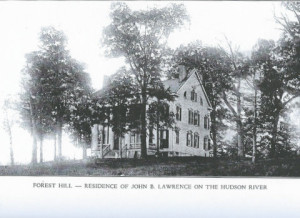
Architectural Description
The Forest Hill house was a substantial mid-nineteenth-century country residence, probably erected in a restrained vernacular interpretation of the Greek Revival style that was common on Hudson River estates between the 1830s and 1850s.
The structure appears to have been two-and-a-half to three stories in height, constructed of light-colored masonry or painted brick. Its form consisted of a rectangular main block with symmetrical massing. The roof was a moderately pitched side-gable, with tall chimneys rising at the gable ends, indicating multiple interior fireplaces and suggesting that the house was suitable for year-round occupation even though it functioned primarily as a summer residence.
The principal façade was arranged with regular window spacing along a central axis. Tall, vertically proportioned sash windows were aligned evenly across the stories, reinforcing the classical balance of the design. At the center stood a columned portico or porch, probably supported by simple square or slightly tapered columns carrying a shallow pediment or roof. This feature emphasized the entrance and conveyed a degree of architectural dignity without elaborate ornament.
The house occupied a slightly elevated site overlooking the Hudson River and was surrounded by mature woodland. Contemporary images emphasize the heavily wooded setting: large deciduous trees partially frame and obscure the building, underscoring both its physical isolation and the still-forested character of upper Manhattan in the early nineteenth century. Rather than formal gardens or rigid landscaping, the house appears to have been set within a naturalistic environment consistent with the picturesque landscape ideals of the period.
History
Forest Hill was the summer residence of John Burling Lawrence, situated on a wooded rise overlooking the Hudson River in what was then the rural northern portion of Manhattan. During the period of Lawrence family ownership the surrounding land remained largely undeveloped. A nearly continuous forest stretched from the property northward toward the tip of Manhattan Island, giving the estate its name and preserving a distinctly rural atmosphere despite its relative proximity to the expanding city.
Forest Hill served as a seasonal retreat for the Lawrence family during the first half of the nineteenth century, when upper Manhattan was still sparsely settled and characterized by country estates and farmland. The Hudson River corridor attracted merchants, professionals, and intellectuals who sought country houses within convenient distance of New York City.
During the period of Lawrence residence, the naturalist and artist John James Audubon acquired a nearby estate of roughly twenty acres extending from West 155th to West 158th Streets west of Broadway. This placed Forest Hill within a small informal community of Hudson River country seats occupied by individuals connected through social, scientific, and cultural interests.
Natural History and Associations
George Newbold Lawrence, the distinguished American ornithologist and son of John Burling Lawrence, spent many summers at Forest Hill. The property lay directly beneath one of the major migratory bird routes along the Hudson River. From this advantageous vantage point Lawrence conducted numerous observations of birdlife, noting the movements and seasonal appearances of species that later informed his scientific work.
While residing at Forest Hill he developed close friendships with Victor Audubon and John Woodhouse Audubon, the sons of John James Audubon. These relationships linked the Lawrence and Audubon families through shared scientific interests and helped establish the Hudson River estates of upper Manhattan as an early setting for American ornithological observation and collaboration..
Later Development The Forest Hill property was eventually absorbed into the urban grid as Manhattan expanded northward in the late nineteenth century. The site is now occupied by residential development near West 133rd Street and Riverside Drive, with no visible remains of the original house or landscape.