Fenno, Elizabeth Lanier (1916–1969)
The Reno Years and Marriage to the Cowboy: In Reno, Betty joined the circle of Eastern socialites waiting out their six-week residencies. She purchased the historic Mayberry Ranch on the Truckee River for $60,000, later spending thousands more on renovations.
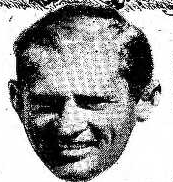
During this period, she met Patrick Henry (“Pat”) Walters, (right) a handsome cowboy and rodeo performer at the Washoe Pines Ranch, who quickly became her co According to the San Francisco Examiner (December 3, 1944), “The days with Pat were filled with fun and the nights with moonshine.” Walters, who could “tame wild horses but not women,” was widely admired in Reno’s dude-ranch society for his horsemanship and rugged charm. Gradually, one by one, the lone cowboy shortened the line sf suitors for Betty’s jeweled hand and heart and after a while he was the only one allowed in her corral. There he paid humble tribute to her beauty and charm in the manner of men form the Harold Bell Wright country.
He proposed and she accepted him on the spot. The stars over the cow country shone brighter. Heaven came very near. The pair married on December 29, 1942, after Betty returned to New York to secure her family’s approval.
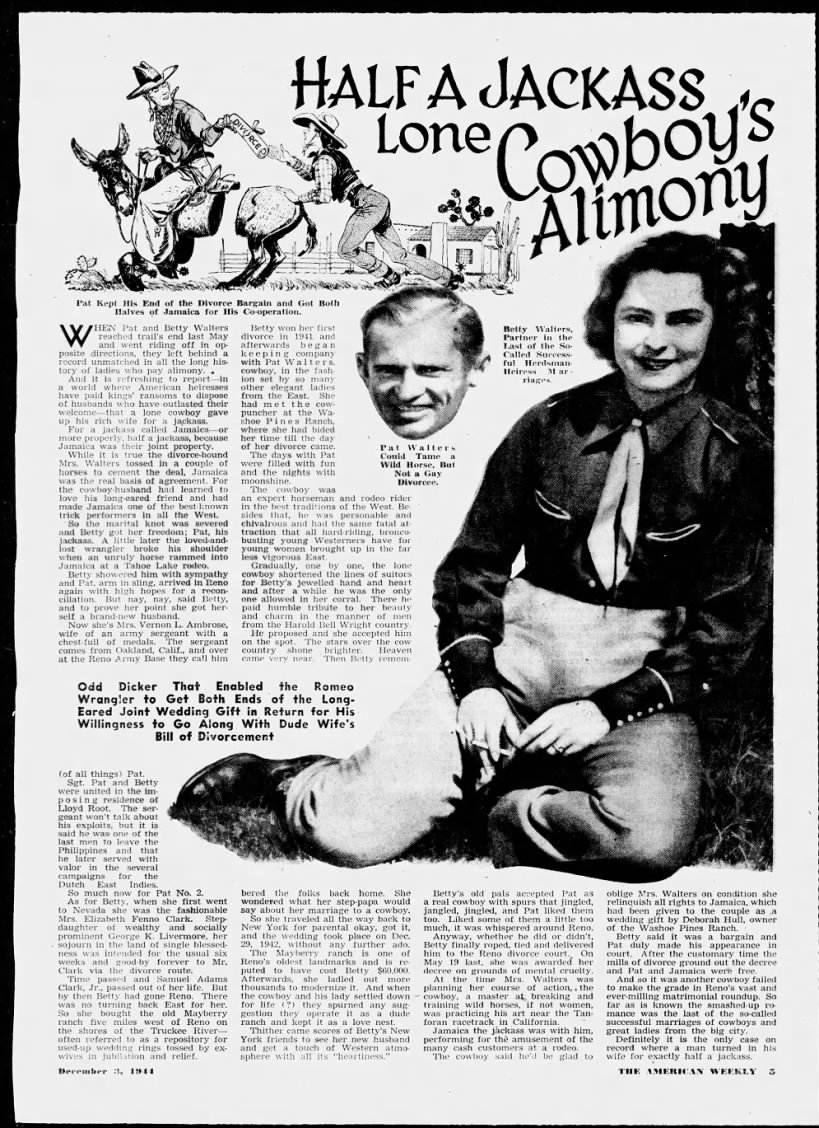
“When Pat and Betty Walters reached trial end last May and parted friends, Betty of El Paso divided the riding off her favorite animal, the jackass. And it is a very American story of law and love’s limitation—beginning over a wedding animal and ending with a divorce in Reno.
Betty Walters, now Mrs. Vernon L. Ambrose, gave up horses for jackasses—more precisely, half a jackass. While it was true the divorce court in Reno frowned on a dead-pan proposal for joint custody of the animal, it was true that Mrs. Walters promised Pat both halves if he’d cooperate with her divorce plan. Pat Walters could tame wild horses—but wasn’t a gay divorcée.
Betty was her first divorcee in 1931 and her second began in El Paso in 1943, keeping Pat in fashion with her plan to have the West’s most unusual divorce. Once the 1st Mrs. Walters had the P in Pat, the 2nd got the W in Walters. The P and W became the talk of the dude ranch set.
For the day of the divorce that finished the dude ranch evenings with Pat was at hand.
The cowboy was romantic and rode the range, and when he returned, the last of the long lines of saturnine ranch riders was ready to bow out. After a while he was the only man who could tell his wife’s will from her won’t. There’s a moral in the moment of western life for urban America—if there’s a Harold Bell Wright country, there’s also a Wright girl country where men go wrong. Thus Betty remounted her western dreams.”
It is always a bad sign when one’s marital troubles occupy a full newspaper page.
Their marriage soon unraveled. As the San Antonio Light (December 3, 1944) reported, “it is refreshing to report that a lone cowboy gave up his rich wife for a jackass.” The “jackass,” a donkey named Jamaica, had been given to the couple as a wedding present by Deborah Hull of the Washoe Pines Ranch. When Betty filed for divorce in 1944, Pat agreed to cooperate—on condition that she relinquish all rights to Jamaica. Betty agreed, and the court granted her a divorce on May 19, 1944, citing “mental cruelty.”
Aftermath and Later Life: Following the divorce, Walters continued performing with Jamaica on the rodeo circuit until he broke his shoulder in an accident at Lake Tahoe. Although Betty offered sympathy, there was no reconciliation. Within months, she married Sergeant Vernon L. Ambrose, an Oakland, California native and decorated veteran who had served in the Philippines and the Dutch East Indies. The couple wed in the home of Lloyd Root near the Reno Army Base, where Ambrose was stationed.
Betty and Vernon Ambrose had one daughter, Elizabeth Ann Ambrose (1946–2006). After her mother’s death, the daughter attempted unsuccessfully to break the spendthrift trust her mother had established for her.
Character and Reputation: Elizabeth Fenno’s tumultuous romantic life, chronicled in full-page features in The American Weekly and major newspapers, epitomized Reno’s wartime divorce culture—where heiresses and cowboys collided in a blend of glamour and absurdity. Her second marriage became a national curiosity: the tale of a cowboy who relinquished his society bride in exchange for “half a jackass.”