de Wardener, Hugh Edward (1915–2013)
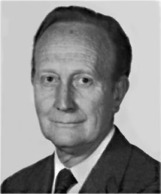
Children: with Janet Lavina Bellis Simon; one son (born 1942);with Jill M. Foxworthy; Gabrielle de Wardener (1961– ); with Josephine Margaret Storey (1935– ): Rudolph James de Wardener (1970–) and Max de Wardener (1972–). Kinship: First cousin once removed of Gabrielle Saportas, the aunt of Regina Matilde Saportas, the wife of Frederick Francis Alexandre, the granduncle of the post–WW II Smith generation.
Early Life and Education
Hugh Edward de Wardener was born in Paris on October 8, 1915, the only child of Baron Edouard de Wardener and Rebecca (“Becky”) Pierce, a physician’s daughter from Albuquerque, New Mexico. His parents’ marriage was brief, and he was raised by his mother and an Alsatian nanny, moving restlessly about Europe. His early schooling took him to Lausanne, Rome, and Florence, before a year in Albuquerque with his maternal grandparents, where he first learned English.
Returning alone to France—escorted only by a ship’s purser—he attended a harsh boarding school in the Pyrenees, where he later recalled learning to swim “to escape being dunked by the bigger boys.” At thirteen he entered Malvern College in Worcestershire after prep school in Sussex. While there he adopted the name “Hugh,” inspired by the fictional hero Bulldog Drummond, and was naturalized a British citizen in 1938. Because of his red hair, he was nicknamed “Ginger.”
His cosmopolitan upbringing continued. His mother directed the Paris office of Bloomingdale’s department store, his holidays were spent between Paris and the Mediterranean, and he was on Majorca at the outbreak of the Spanish Civil War—rescued by HMS Repulse. His family circle included an American opera singer (his stepfather, a bass at the Opéra Comique) and an uncle married to an actress who became directrice of Mainbocher, the celebrated Paris fashion house.
Medical Training and Early Career
Hugh studied medicine at St Thomas’s Hospital Medical School in London and qualified in June 1939. His first post was at Scunthorpe, where within a week he found himself the only physician available. The day before Britain entered the Second World War, he married Janet Lavina Simon. He joined the Royal Army Medical Corps almost immediately, beginning a military service that would define his career and his scientific outlook.
Prisoner of War and Wartime Research
De Wardener arrived in Singapore on the last ship before its fall to the Japanese in 1942 and spent three and a half years as a prisoner of war. He was first interned in Changi and then sent north to Siam (Thailand) to work on the Burma–Siam Railway.
Even in captivity he pursued clinical observation and research. In Changi he identified and documented cases of Wernicke’s encephalopathy among malnourished POWs, showing that the disease resulted from vitamin B₁ deficiency rather than alcoholism. His findings were published in The Lancet (1947) as “Cerebral beriberi [Wernicke’s encephalopathy]: Review of 52 cases in a Singapore prisoner-of-war hospital.”
He also analyzed a cholera outbreak among POWs on the railway, producing another Lancet paper in 1946. His field notes—buried in a soldered biscuit tin under a grave at Chungkai Cemetery—survived the war. Other accounts describe his improvised inoculations for diphtheria using serum from recovered prisoners, a procedure credited with saving lives. For his courage and medical innovation under extreme hardship he was appointed MBE (Military) in 1946.
Postwar Medical Career
After demobilization de Wardener resumed work at St Thomas’s Hospital and later became Professor of Medicine at Charing Cross Hospital. His wartime experience inspired a lifelong commitment to clinical investigation and compassionate patient care.
He was one of Britain’s leading renal specialists, contributing to the understanding of renal physiology, hypertension, and dialysis treatment. His Renal Physiology (1961) and numerous papers were foundational texts for later nephrologists. He served as President of the Renal Association (1974–1977) and influenced national kidney-disease policy.
A modest and humane physician, he was known for mentoring generations of students and for his insistence that clinical medicine should remain rooted in observation of the patient, not just the laboratory. He retired in 1981 but continued to write and lecture.
Later Life and Family
After his first marriage ended in 1977, he married Diana Crawshaw; later Jill Foxworthy, with whom he had a daughter, Gabrielle; and finally Josephine Margaret Storey, with whom he had two sons, Rudolph James and Max de Wardener. His younger son Max became a noted composer and musician, while Rudolph pursued a career in the arts.
Hugh Edward de Wardener died in London on September 29, 2013, aged 97, having been one of the longest-lived and most honored British physicians of his generation.
Legacy
Sir Hugh’s life embodied scientific rigor, moral courage, and cosmopolitan sensibility. His pioneering work in nutritional neurology and renal medicine, combined with the heroism of his POW years, placed him among the outstanding clinician-researchers of the twentieth century.