Cliffside
Architect
Josiah Cleveland Cady (1837–1919) was a leading New York City architect of the late 19th and early 20th centuries, celebrated for his mastery of Victorian-era styles, including High Victorian Gothic and Ruskinian Gothic. Born in Providence, Rhode Island, he briefly studied at Trinity College in 1857 before apprenticing in architecture, likely in New York, and establishing his own practice in 1868. His firm, evolving into Cady, Berg & See by the early 1870s, produced an extensive portfolio of public and institutional buildings, such as the original Metropolitan Opera House (1883–1890), the south range of the American Museum of Natural History (1877), and multiple structures at Yale University—including the Law School and Peabody Museum—as well as buildings at Wesleyan, Trinity, and Williams Colleges. Cady’s work often emphasized robust, textured forms and integration with natural surroundings, reflecting his training and the era’s emphasis on picturesque compositions.
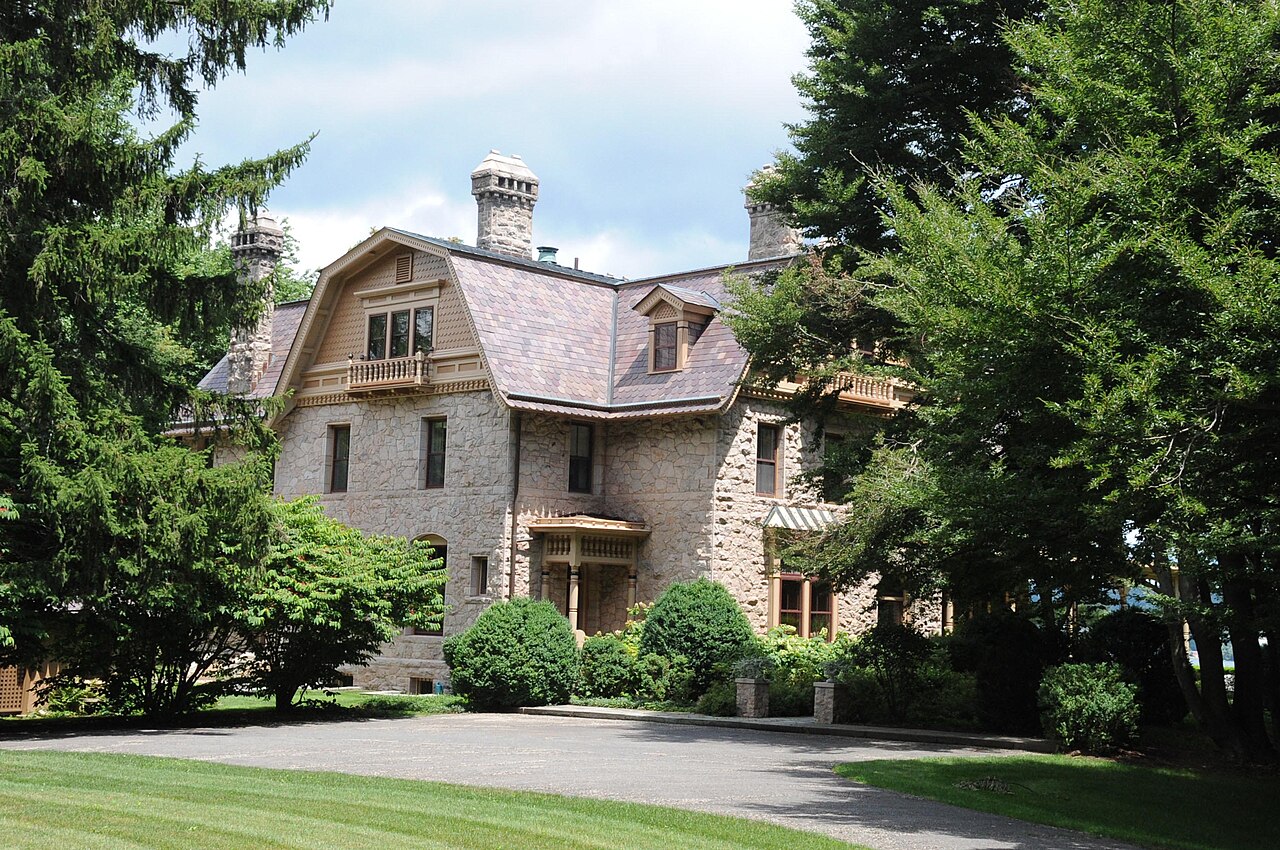
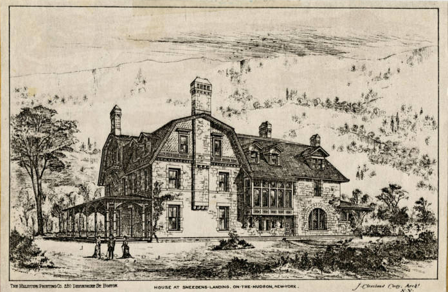
Architectural Description Cliffside is a substantial two-story, L-shaped stone country house designed in the Flemish Colonial Revival style. Built of random rubble stone, the house is capped by a steep cross-gambrel roof punctuated by dormers and multiple tall stone chimneys, giving it a strong vertical profile when viewed against the wooded Palisades. A one-story wraparound verandah with balustrades extends along the principal elevations, mediating between the interior rooms and the surrounding landscape. The composition emphasizes solidity and picturesque massing rather than strict symmetry, with carefully varied rooflines and fenestration. Sited high above the Hudson River, the house commands long views across the water toward Dobbs Ferry and the eastern shore.
The estate’s landscape features a park-like setting with original plantings from 1876, including specimen trees imported by owner Henry Effingham Lawrence, an amateur horticulturist, who collaborated with neighbor Winthrop S. Gilman, Jr., to introduce rare varieties from Europe and the Orient, often planted in symmetrical pairs to frame vistas and define the grounds.
Interior Description The interior of Cliffside was designed to support both family life and cultivated leisure. A central stair hall organizes circulation, rising through the house and lit by a large stained-glass window. Principal reception rooms were arranged to take advantage of river views and natural light. The drawing room was notable for housing a pipe organ, an unusual feature in a private residence, reflecting the owner’s interest in music and social gatherings. Extensive wainscoting and wood paneling provided warmth and enclosure, consistent with late nineteenth-century taste. The house also contained Henry Effingham Lawrence’s collection of Hudson River School paintings, reinforcing the close relationship between the interior spaces and the surrounding landscape. Service and storage areas in the basement included practical systems such as spring-fed cooling for food storage.
History Cliffside was built in 1876 for Henry Effingham Lawrence (1829–1900). Lawrence and his family had long summered at a nearby farm known as Arcadia at Snedens Landing, opposite Dobbs Ferry. In 1870, Lawrence began assembling a large tract of land along the Hudson River, eventually acquiring more than a mile of waterfront. Cliffside marked a decisive transition from farm-based summering to a purpose-built country seat.
Following Henry E. Lawrence’s death on July 10, 1890, the property passed to his wife, Lydia Underhill Lawrence, who inherited the house along with surrounding riparian lands exceeding a mile of Hudson River frontage. Under her stewardship, Cliffside evolved as a family compound, with Lydia exerting control over local development and contributing to community institutions, such as donating 1,100 books in 1891 to establish Palisades’s first library in The Big House. Key modifications during this period included enhancements to the estate’s park-like grounds, where Lawrence family members, including Henry as an amateur horticulturist, imported rare trees from Europe and the Orient, often in symmetrical pairs, in collaboration with neighboring landowner Winthrop S. Gilman, Jr. A surviving carriage house north of the main structure, built as part of these expansions, complemented the original design by architect J. Cleveland Cady.
By the early 20th century, ownership transitioned within the family to their daughter, Mary Trimble Lawrence Tonetti (1868–1945), a noted sculptor who married fellow artist François Tonetti. Mary expanded the estate’s role as a creative hub, acquiring additional properties in the Snedens Landing area and leasing improved houses at modest rents to artist friends, effectively transforming the surrounding enclave into an informal community while retaining Cliffside as the family’s anchor (see Snedens Landing). This period marked a subtle shift toward seasonal and communal use among heirs, though the property continued under direct family oversight without sale to outsiders.
Cliffside remained in the Lawrence family until just after World War II. It survives as one of the most important nineteenth-century country houses in the Palisades.