Chisholm Mansion
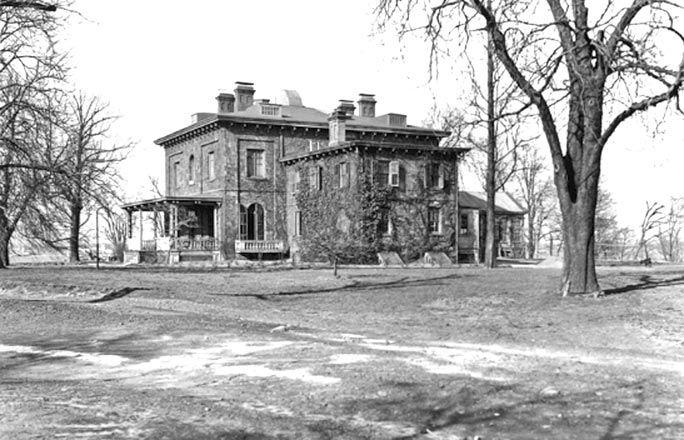
Architectural Description
The Chisholm Mansion was a substantial mid-nineteenth-century stone country house prominently sited on high ground overlooking the East River at the northern tip of College Point. Built of locally quarried bluestone, the house presented a compact but imposing rectangular mass with a low hipped roof, deep eaves, and multiple chimneys. Its elevations were regular and restrained, with tall rectangular windows and a central entrance accented by classical detailing. A broad porch on the river-facing side softened the severity of the stone walls and oriented the principal rooms toward expansive water views stretching toward Manhattan, the Bronx, Rikers Island, and, later, the site of the Whitestone Bridge. Set within approximately twenty to twenty-eight acres of landscaped grounds, the mansion combined solidity with picturesque siting, emphasizing prospect and elevation rather than ornament.
History
The origins of the estate date to 1835, when Reverend William Augustus Muhlenberg, an Episcopal clergyman and founder of St. Paul’s College, purchased the land for a planned stone seminary. Construction began, but the Panic of 1837 abruptly ended the project, leaving unused stone on the site. The property was subsequently acquired by Muhlenberg’s sister, Mrs. John Rogers, who repurposed the abandoned materials to build a private residence. Completed around 1848 on the highest point of the grounds, the house was given as a wedding gift to her daughter, Mary Ann Rogers, upon her marriage to William Edings Chisholm, a real-estate broker and developer who had attended St. Paul’s College.
The Chisholm family occupied the mansion for several generations, raising three children there—George, Margaret, and Benjamin—and establishing the house as a long-term family seat rather than a seasonal retreat. Contemporary descriptions emphasized its commanding river views, extensive grounds, and sense of seclusion despite proximity to New York City. Some later accounts suggest the house may have served as a refuge for fugitive slaves before the Civil War, though documentation is limited. By the late nineteenth and early twentieth centuries, the property was widely known locally as Chisholm’s, and the surrounding shoreline parkland took its name from the estate.
In 1930, amid changing economic circumstances following the stock market crash of 1929, the Chisholm family sold the property to the City of New York for use as a public park. In a brief and unusual chapter of its history, Mayor Fiorello La Guardia used the mansion as a “Summer City Hall” in 1937, conducting municipal business there during the hottest months. Despite this high-profile use, Parks Commissioner Robert Moses regarded the aging structure as impractical to maintain or adapt. Between 1939 and 1941, the mansion was demolished as part of a Works Progress Administration project to redevelop the site with playgrounds, athletic fields, and recreational facilities.
Today, the former estate is preserved as Hermon A. MacNeil Park, a popular waterfront green space. A flagpole marks the approximate location of the mansion.