Caldwell, Mary Gwendolyn [Gwendolin] “Mamie” Byrd (1863–1909)
Early life and inheritance
Mary Gwendolyn Caldwell was born in Louisville, Kentucky, in 1863. After her mother’s death (1867) and her father’s death (1874), she and her younger sister, Mary Elizabeth (“Lina”), inherited a very large fortune derived from the Caldwell gas-lighting enterprises. She was educated at the Academy (Convent) of the Sacred Heart, Manhattanville, New York.
Founding benefactor of The Catholic University of America
Upon attaining her majority, and in consultation with John Lancaster Spalding (then a priest and later bishop of Peoria), Caldwell offered to endow a national Catholic university. Her benefactions included the site in Washington, D.C., and the erection and early maintenance of the first buildings; Caldwell Hall (dedicated May 24, 1888) bears her name. An official university page notes the papal approval letter of April 10, 1887 sealed in the cornerstone and identifies her as the first donor.
In recognition of these benefactions she received high honors: the Laetare Medal (1899) from the University of Notre Dame, and a papal decoration (contemporary accounts describe a medal specially struck by Pope Leo XIII).
Engagement, marriage, and separation
In 1889 she briefly became engaged to Prince Murat; the engagement ended over financial terms. In Paris on October 19, 1896, she married the Marquis des Monstiers-Mérinville. The couple separated in 1905; contemporary reports indicate she paid him an annual stipend to avoid divorce while retaining her title.
Allegations concerning Bishop John Lancaster Spalding
Beginning in 1901, private and later public statements by the Caldwell sisters alleged long-standing sexual misconduct by Spalding; the claims, their reception, and the archival treatment of related materials have been debated by historians. The standard scholarly defense of Spalding is C. Walker Gollar’s “The Double Doctrine of the Caldwell Sisters” (Catholic Historical Review, 1995), which questions the sisters’ reliability and attributes their accusations to illness, unhappy marriages, and ecclesiastical disputes (e.g., an annulment).
A later methodological review by Gollar discusses how earlier Spalding scholarship (notably under John Tracy Ellis) handled and, at points, omitted or minimized sensitive correspondence, reflecting broader archival and historiographical issues surrounding the case. (This article analyzes editorial practice and transmission of documents rather than adjudicating facts of the alleged relationship.)
Counter-narratives exist in modern commentary arguing that church officials privately took the sisters’ claims seriously enough to affect Spalding’s prospects for promotion, though these accounts rely on correspondence and summaries not all of which are publicly reproduced in full; they should be treated cautiously and weighed against the peer-reviewed literature.
Lina Caldwell (Mary Elizabeth) and the public break with Rome (context)
Her sister Lina funded Caldwell Chapel at the university and later published The Double Doctrine of the Church of Rome (1906), a polemical work critiquing Jesuit casuistry and “probabilism,” reflecting the sisters’ break with Catholic authorities in the early 1900s.
Later years and death
Caldwell suffered from chronic illness in her last years. She died aboard the German liner Kronprinzessin Cecilie while it waited to dock in New York Harbor on October 5, 1909; bright’s disease was reported as the cause of death. She was buried in Cave Hill Cemetery, Louisville.
Legacy
As the initiating benefactor of The Catholic University of America, Caldwell played a decisive role in creating a national center for Catholic higher education in the United States; Caldwell Hall and the early history of the university remain linked to her patronage. Her Laetare Medal recognized that contribution at the national Catholic level.
She and her sister both renounced the Catholic Church. The Caldwell sisters were buried in a secular cemetery, not in their father’s grave in the Catholic cemetery in Louisville. On their monument stands the inscription: You shall know the truth, and the truth shall set you free.
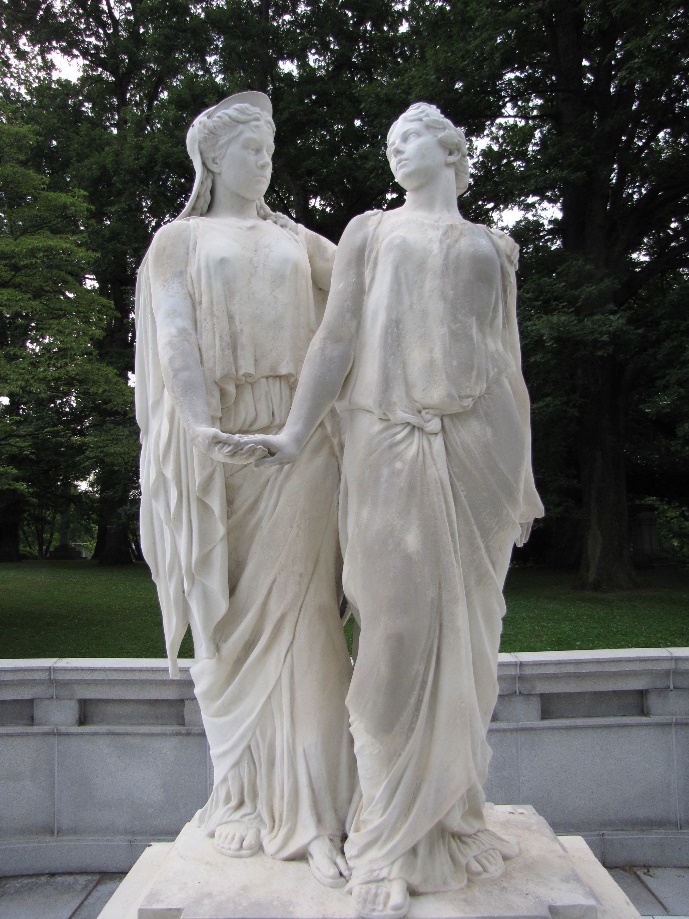
The monument was restored with funds from the Catholic University of America.