Burling, Thomas (1746–1831)
Early Life and Apprenticeship Thomas Burling was born in 1746, the son of Ebenezer Burling and Mary Lawrence, members of the Society of Friends. The Burlings were part of a closely knit Quaker community in Flushing and New York that included craftsmen, merchants, and clockmakers. Thomas was the first cousin of the noted Quaker clockmaker Effingham Embree, and the two may have collaborated, with Thomas crafting the fine mahogany cases for Embree’s longcase clocks.
Burling trained as a cabinetmaker under Samuel Prince, a leading New York artisan whose workshop produced some of the city’s finest furniture in the English taste. Under Prince’s influence, Burling acquired the technical and aesthetic skill that would soon make him one of the foremost cabinetmakers in the early United States.
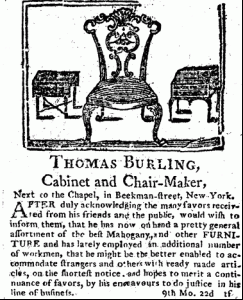
Cabinetmaker to the New Republic By the 1780s Burling had established his own shop on Beekman Street in lower Manhattan, where he produced high-quality mahogany furniture for New York’s mercantile elite. His reputation for craftsmanship and design brought him to national attention in 1789 when Congress leased the Samuel Osgood house at 3 Cherry Street to serve as the first presidential residence.
The furnishings for the residence were purchased locally, and Burling’s workshop supplied much of the mahogany furniture. According to the records of the U.S. Treasury and later summarized by the Mount Vernon Ladies’ Association, “With the exception of the upholsterer’s charges, the greatest sum for furnishings was paid to Thomas Burling for ‘mahogany furniture,’ which contributed to what Martha Washington called a ‘handsomely furnished house.’” In all, Congress spent approximately $8,000 preparing the house for the Washingtons—an enormous sum for the time, and a testament to Burling’s reputation.
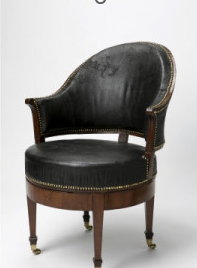
The “Uncommon Chair” for George Washington Among Burling’s most celebrated creations was the so-called “Uncommon Chair,” commissioned by George Washington in 1790. On April 17 of that year, Washington paid Burling £7 for a uniquely engineered armchair combining the curved, upholstered design of a French bergère en gondole with an innovative swivel seat mounted on four bone rollers.
Washington valued the chair’s comfort and practicality, using it throughout his presidency and later in his study at Mount Vernon. The chair remains in the Mount Vernon collection, where it is regarded as one of the earliest examples of American ergonomic furniture.
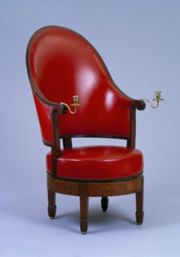
Jefferson’s Commissions In the same year, Thomas Jefferson, then Secretary of State, also ordered furniture from Burling while living in New York. Jefferson’s Memorandum Book records two payments totaling £143 to Burling in July and August 1790, apparently for a sofa and a revolving chair similar to Washington’s. Jefferson’s version, now at Monticello, provoked Federalist satire: Representative William Loughton Smith derided Jefferson’s “wonderful Whirligig Chair, which had the miraculous quality of allowing the person seated in it to turn his head without moving his tail.”
These commissions linked Burling to two of the most influential founders of the United States and placed his work at the heart of early American design.
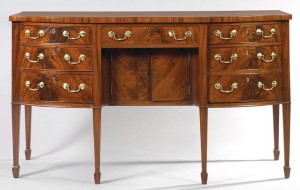
Later Career and Retirement Burling’s furniture continued to be sought after by New York’s wealthy families during the Federal period. His style reflected the transition from late Chippendale to early Federal neoclassicism, characterized by fine veneers, delicate proportions, and restrained ornament. His mahogany chairs, sideboards, and cabinets were known for precise joinery and elegant symmetry.
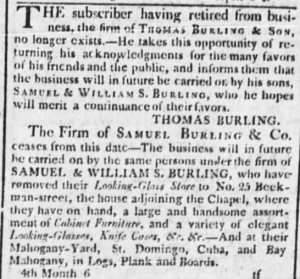
In April 1802, after more than three decades in business, Thomas Burling retired and turned his shop over to his sons Samuel and William Burling, who continued the family’s furniture-making tradition into the early nineteenth century.
Death and Legacy Thomas Burling died in 1831. His surviving furniture—particularly the Washington and Jefferson chairs—represents the intersection of craftsmanship, innovation, and the civic aspirations of the early Republic. His name endures among collectors and historians as one of the premier artisans of the Federal era.