Bradish Johnson House
Architect
Lewis E. Reynolds (active c. 1868–1885) was a New Orleans architect best known for his technically sophisticated interior planning and his mastery of stair design during the post–Civil War period. His birth and death dates are not firmly documented, but his professional activity is well attested in New Orleans architectural records from the late 1860s through the mid-1880s. Reynolds is believed to have received formal architectural training, possibly including exposure to European or academic design principles, which is reflected in his fluent handling of French Second Empire and Beaux-Arts–influenced forms. He is particularly associated with advanced stair construction and circulation planning; in 1875 he published A Handbook of Stair-Building, a nationally circulated technical manual that established him as an authority on the subject and influenced American builders well beyond Louisiana. In New Orleans, Reynolds designed a number of substantial residences for elite clients during the Reconstruction and early Gilded Age years, including the Bradish Johnson House at 2343 Prytania Street, where the grand circular stair is a defining feature. His work is characterized by careful structural logic, refined interior composition, and a restrained but confident use of ornament. Although less widely known today than contemporaries such as James Freret, Reynolds is increasingly recognized by architectural historians for his technical contributions and for designs that combine academic sophistication with practical construction expertise.
Architectural Description
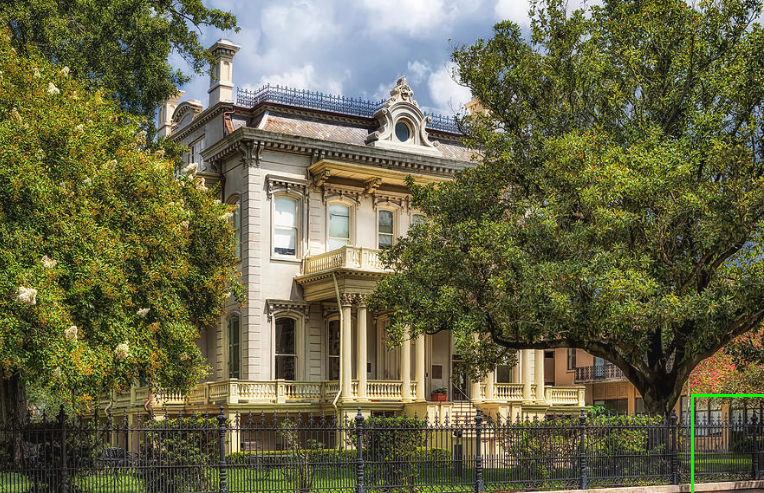
The Bradish Johnson House is a monumental Second Empire mansion distinguished by its concave mansard roof crowned with ornate iron cresting, tall pedestal chimneys, and a prominent bull’s-eye dormer centered above the principal façade. The exterior is organized around a raised basement and grand central stair leading to a columned portico with Corinthian columns and an upper balcony. A heavy bracketed cornice, molded window surrounds, and symmetrical massing reinforce its formal, cosmopolitan character. The interior historically featured an elaborate circular staircase, a design element closely associated with Lewis E. Reynolds, who published a contemporary handbook on stair construction.
Original Ownership and Use
The house was built as a private residence for Bradish Johnson, a wealthy sugar planter and industrialist originally from New York, and his wife, Louisa Ann Lawrence. Johnson owned multiple Louisiana sugar plantations and operated a New York distillery, dividing his time between New Orleans, Long Island, and New York City. The mansion served as a post–Civil War statement of wealth and status in the rapidly developing Garden District and reportedly cost approximately $100,000 to construct, a very large sum for the period.
Later History
Following Bradish Johnson’s death in 1892, the house passed through several owners, most notably Walter Denegre, who occupied the residence until 1929. That year the property was acquired by the Louise S. McGehee School, a private all-girls school founded in 1912. The mansion became the school’s principal building and remains its architectural centerpiece. Over time, the school expanded its campus across much of the 2300 block of Prytania Street by incorporating adjacent historic house